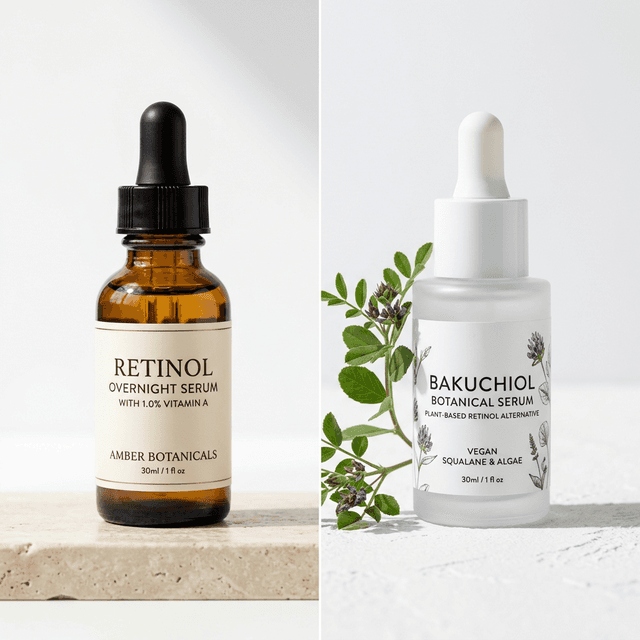
Retinol has been the undisputed king of anti-aging skincare for decades. Then bakuchiol showed up — plant-derived, gentle, pregnancy-safe — and suddenly everyone started asking: is bakuchiol actually as good as retinol? Or is it just a milder, less effective alternative for people who can't handle the real thing?
The honest answer is more nuanced than either camp admits. Let's break it down properly.
What Is Retinol?
Retinol is a form of vitamin A. It belongs to the retinoid family — a group of compounds that includes prescription-strength tretinoin at one end and gentler over-the-counter (OTC) retinol esters at the other.
When applied to skin, retinol converts to retinoic acid, the active form that binds to receptors in skin cells and triggers a cascade of benefits:
- Accelerates cell turnover — speeds up the shedding of dead cells and production of new ones
- Boosts collagen synthesis — directly stimulates fibroblasts to produce more collagen
- Fades hyperpigmentation — reduces melanin production and distributes pigment more evenly
- Unclogs pores — normalizes the way skin cells shed inside follicles, reducing breakouts
- Smooths texture — one of the most consistent results users report
The evidence behind retinol is decades-deep. It is, genuinely, one of the most well-researched topical actives in dermatology.
The Downsides of Retinol
- Retinization period: For the first 4–8 weeks, many users experience dryness, flaking, redness, and sensitivity. This is often called "the purge."
- Photosensitivity: Retinol makes skin more sensitive to UV. Sunscreen becomes non-negotiable — day and night users included.
- Not safe during pregnancy: All retinoids are contraindicated during pregnancy and breastfeeding.
- Requires a slow introduction: Starting too high, too fast causes significant irritation.
What Is Bakuchiol?
Bakuchiol is a meroterpene compound extracted from the seeds and leaves of Psoralea corylifolia (babchi plant), which has been used in Ayurvedic and traditional Chinese medicine for centuries.
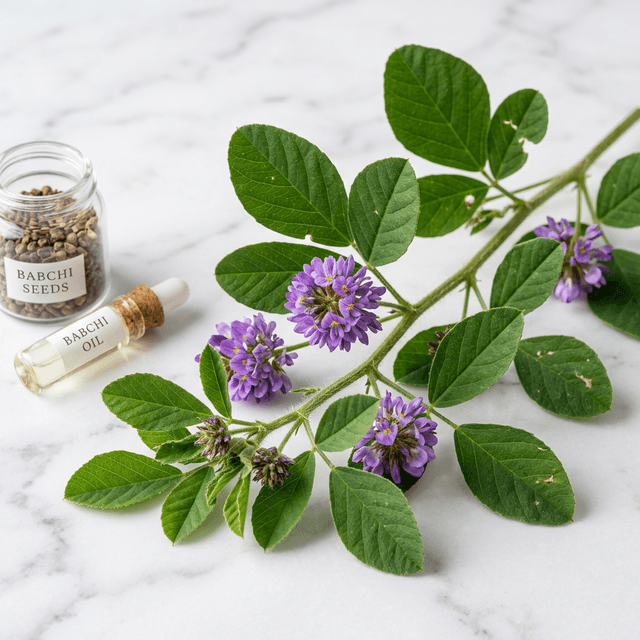
It was largely overlooked by cosmetic science until a landmark 2019 study in the British Journal of Dermatology directly compared it to retinol. The results were surprising enough to start a serious conversation.
Bakuchiol works differently from retinol at the molecular level, but it appears to activate some of the same retinol-response genes in skin cells — including genes involved in collagen synthesis, cell turnover, and pigmentation control.
What Bakuchiol Delivers:
- Reduced fine lines and wrinkles
- Improved skin firmness and elasticity
- More even skin tone
- Similar collagen-stimulating effect to low-strength retinol
What Makes It Different:
- No purge period — tolerated well from the very first use
- No photosensitivity — can be used morning or evening
- Safe during pregnancy — no restrictions
- Antioxidant properties — retinol doesn't offer this additional benefit
Head-to-Head Comparison
What we compare
Retinol
Faster and strongerBakuchiol
Softer and easier to tolerateAnti-aging efficacy
Maximum visible performance
Very good results with a gentler feel
Speed of results
Usually faster: around 4–8 weeks
Usually slower: around 8–12 weeks
Irritation risk
High, especially at the start
Very low
Photosensitivity
Yes, so diligent SPF is essential
No, usable AM or PM
Safe in pregnancy
No
Yes
Antioxidant effect
No standout antioxidant support
Offers antioxidant support
Cost
Low to medium
Medium to high
Best for
Aging concerns, acne, uneven texture
Sensitive skin, pregnancy, beginners
What Does the Research Say?
Key double-blind research from 2019 (Dhaliwal et al., British Journal of Dermatology) randomized 44 participants into 0.5% retinol or 0.5% bakuchiol groups twice daily for 12 weeks. Results:
- Both groups showed significant reduction in wrinkle surface area and hyperpigmentation
- No significant difference in efficacy between the two at this concentration
- The retinol group experienced significantly more scaling and stinging
This is the study that launched bakuchiol into the mainstream. But note: the comparison was against 0.5% retinol — a mild-to-moderate strength. High-strength retinol or prescription tretinoin remains considerably more powerful.
A 2021 review in the Journal of Cosmetic Dermatology confirmed bakuchiol's safety profile and comparable results to low-strength retinol, while noting the need for more long-term data.
Can You Use Both Together?
Yes — and many dermatologists now recommend it. Combining retinol with bakuchiol has shown additive benefits in some formulations:
- Bakuchiol’s antioxidant properties may help stabilize retinol, which is notoriously prone to breaking down when exposed to light and air.
- Bakuchiol reduces retinol-induced irritation by calming the skin's inflammatory response
- Combined, they may allow lower retinol concentrations to be used while maintaining efficacy
Tip: If you want to try retinol but worry about irritation, start with a low-strength retinol + bakuchiol combination product. Many brands now offer exactly this.
Who Should Choose Retinol?
- Skin already accustomed to actives and no significant sensitivity issues
- Targeting more advanced signs of aging (deeper wrinkles, significant texture issues)
- Breakout-prone skin — retinol’s pore-normalizing effect is significantly more potent
- Those not pregnant or breastfeeding
Start at: 0.025% or 0.05%, two to three times per week, building slowly.
Who Should Choose Bakuchiol?
- Sensitive, reactive, or rosacea-prone skin
- Pregnant or breastfeeding women who want anti-aging benefits
- Complete beginners to actives
- Anyone who has tried retinol and found it too irritating
- Those wanting to use an active in both AM and PM routines
FAQ
Is bakuchiol as effective as retinol?
At similar concentrations (0.5%), clinical studies show comparable results for fine lines and pigmentation, with significantly less irritation. High-strength retinol or tretinoin remains more powerful overall.
How long does bakuchiol take to work?
Most users notice improvements in skin texture and tone after 8–12 weeks of consistent use. Retinol typically shows results slightly faster at 4–8 weeks.
Can I use bakuchiol if I'm pregnant?
Yes, bakuchiol is considered safe during pregnancy. Retinol — in any form — should be avoided during pregnancy and breastfeeding.
Should I use retinol or bakuchiol in the morning?
Retinol is best used at night (photosensitivity and instability in light). Bakuchiol can be used morning or evening — it's a genuine flexibility advantage.
Can I combine bakuchiol with other actives?
Yes. Bakuchiol pairs well with niacinamide, vitamin C, hyaluronic acid, and even low-strength retinol. It's one of the most compatible actives available.
Bottom Line
Retinol is still the most evidence-backed anti-aging ingredient available in over-the-counter (OTC) skincare. If your skin tolerates it, the results are hard to match.
But bakuchiol is not a compromise or a "gentle alternative for sensitive types." It's a genuinely effective active in its own right — and for pregnant women, sensitive skin, or anyone building their first active routine, it's the smarter starting point.
The good news? You don't have to choose. Used together, at the right concentrations, they complement each other well.
Related reading: