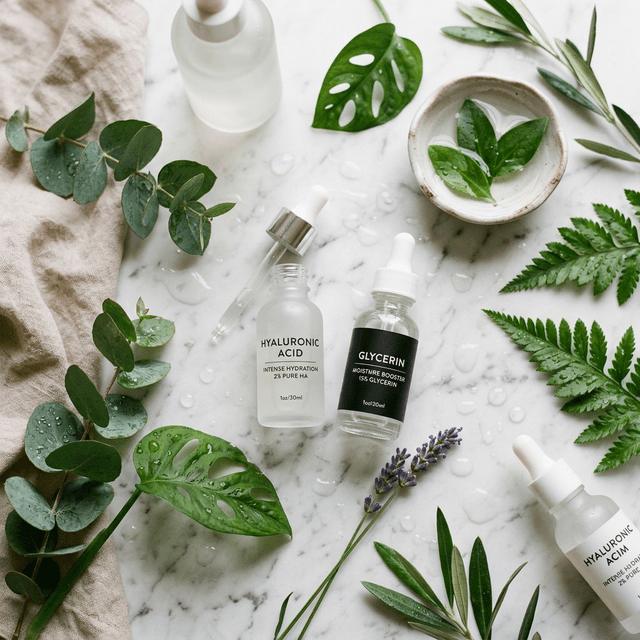
Walk into any pharmacy and pick up a moisturizer—any one. Flip it over and read the ingredients. It will almost certainly contain either hyaluronic acid, glycerin, or both. These two dominate the hydration category like no other ingredients in skincare.
Yet most people using them have no real idea how differently they behave, or why that matters. They attract water through different mechanisms, respond differently to climate, and fail in different conditions. Knowing which to lean on—and when—changes how your skin actually feels.
What Is Hyaluronic Acid?
Hyaluronic acid (HA) is a naturally occurring polysaccharide—a large sugar molecule—found abundantly in your body: in the fluid that cushions your joints, in the vitreous of your eyes, and critically, in your skin's dermal layer.
Naturally occurring HA in your dermis acts as a sponge capable of binding up to 1,000 times its own weight in water. This remarkable capacity is what makes youthful skin look plump, springy, and smooth. As we age, our natural HA levels drop significantly—one of the key drivers of the gradual dehydration and volume loss we associate with aging skin.
In topical skincare, HA is a humectant: it draws water from the environment and from deeper layers of the skin up into the epidermis where it's visible and tactile.
The Key Variables: Molecular Weight
Not all HA is created equal. The molecular weight of HA determines how deeply it penetrates:
- High Molecular Weight HA (>1,000 kDa): Sits on the surface, forms a film, provides instant plumping and a smooth, silky texture. Cannot penetrate.
- Low Molecular Weight HA (<50 kDa): Penetrates the epidermis, delivers hydration at a deeper level, but may cause mild irritation at very low concentrations.
- Sodium Hyaluronate: The salt form—smaller molecule, penetrates more easily, highly stable. The version you'll see most commonly on ingredient labels.
Premium formulas frequently combine two or three molecular weights for layered hydration at multiple depths.
What Is Glycerin?
Glycerin (also called glycerol) is a simple polyol molecule derived from either plant oils (vegetable glycerin) or animal fats. It has been used in skincare for over a century—long before hyaluronic acid became the beauty industry's darling.
Like HA, glycerin is a humectant. It draws moisture from the atmosphere into the skin. But unlike HA, it does something HA cannot: it also communicates directly with aquaporins—the specialized protein channels in cell membranes that regulate water transport in and out of skin cells.
This is a crucial distinction. Glycerin doesn't just attract water to the skin's surface. It actively helps normalize the skin's hydration transport machinery at a cellular level.
Glycerin's Additional Talents
- Moderate antimicrobial effect — (at high concentrations)
- Barrier repair — contributes to the integrity of the stratum corneum
- Skin feel — gives products a comfortable, non-sticky finish at concentrations below 5%
- Cost-effectiveness — dramatically cheaper than HA, making it a more generous inclusion in formulations
Head-to-Head: The Key Differences
| Property | Hyaluronic Acid | Glycerin |
|---|---|---|
| Molecule Type | Polysaccharide | Polyol |
| Hydration Mechanism | Draws water, surface film | Draws water + activates aquaporins |
| Penetration Depth | Surface to mid-epidermis (varies by MW) | Surface to epidermis |
| Water-Binding Capacity | Up to 1,000× its weight | ~3× its weight |
| Barrier Repair | Indirect (via ceramide support) | Direct |
| Anti-inflammatory effect | Moderate (especially LMWHA) | Moderate |
| Texture in Products | Lightweight gel, water-serum | Can feel slightly tacky above 5% |
| Price Point | High | Low |
| Climate Performance | Needs humidity to work optimally | More stable in dry climates |
The Climate Problem: When Hyaluronic Acid Backfires
This is the piece of HA's story that almost no brand will tell you.
Hyaluronic acid draws water from wherever water is available. In a high-humidity environment—a steamy bathroom, a tropical climate, a well-humidified room—it draws water from the air, and your skin stays plump.
In a dry, low-humidity environment (think: central heating in winter, air conditioning in summer, arid climates), HA has no atmospheric moisture to draw from. So it does the only thing it can: it draws water upward from your dermis and deposits it in the epidermis—where it then evaporates, leaving your deeper skin layers more dehydrated than before.
The Fix: Always seal hyaluronic acid with an occlusive or emollient moisturizer. HA draws the water; the moisturizer locks it in. Without this step, particularly in dry climates, you may actually worsen dehydration.
Glycerin doesn't share this problem to the same degree, making it particularly reliable in harsh weather conditions.
How to Use Them Together
The good news: you don't have to choose. The two ingredients are synergistic, not competitive.
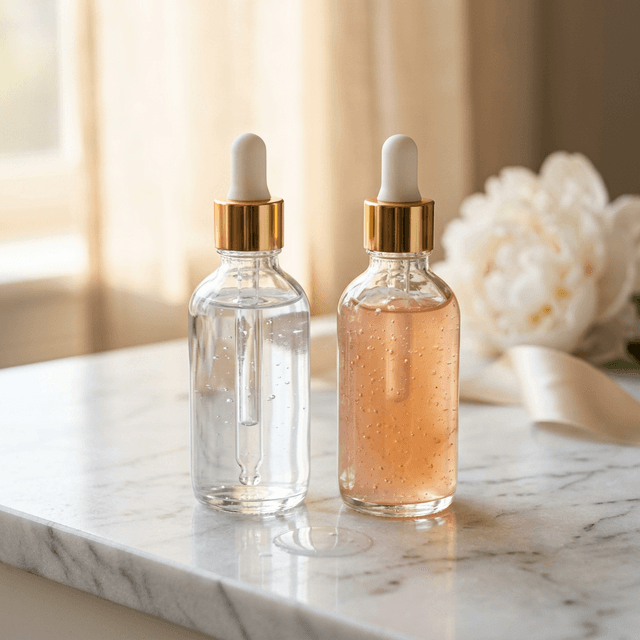
The High-Performance Layering Protocol:
- Cleanse — start with a clean, slightly damp face (the residual water is the first thing HA will bind to)
- Hyaluronic Acid Serum — apply on damp skin; let it sit for 30 seconds
- Glycerin-rich Essence or Toner — adds cellular hydration support
- Moisturizer with Ceramides — the essential occlusive seal; locks everything in
- SPF (AM only) — protects against the photodamage that compounds existing dehydration
For the simplest approach, look for a single serum or moisturizer that contains both (you'll find them on most good ingredient lists).
Who Needs What Most?
Choose to prioritize Hyaluronic Acid if:
- Your primary concern is fine lines and surface dehydration
- You live in a humid climate
- Your skin feels tight but not flaky
- You want visible plumping from your serum
Choose to prioritize Glycerin if:
- You live in a dry, cold climate with central heating
- Your skin barrier is compromised or reactive
- You're dealing with mild acne alongside dryness
- You want maximum cost-effectiveness
Use both if:
- All of the above apply
- You're building a serious hydration-focused routine
Frequently Asked Questions
Can I use hyaluronic acid and glycerin at the same time?
Yes—absolutely. They're synergistic. Many excellent serums contain both precisely because they hydrate through different mechanisms.
Which one is better for anti-aging?
Hyaluronic acid delivers more dramatic short-term results thanks to its superior water-binding capacity and immediate plumping effect. Long-term, glycerin's barrier repair properties contribute to sustained skin resilience.
Can I apply pure glycerin directly?
Avoid applying undiluted glycerin (100%) to the skin. At high concentrations it can actually draw water out of the skin. Formulations at 3–10% glycerin are ideal.
Does hyaluronic acid filler work the same way as topical HA?
No. Injectable HA filler is cross-linked (chemically modified to resist breakdown) and deposited directly into the dermis where it can hold volume. Topical HA cannot penetrate to the dermis in any meaningful quantity.
The Bottom Line
Hyaluronic acid gets all the attention. Glycerin gets all the real work done.
Hyaluronic acid's remarkable 1,000× water-binding power makes it the most dramatic short-term hydrator available in skincare. Its role in every intelligent anti-aging routine is unquestionable. But without the right conditions—humidity, a sealing layer, the right molecular weight—it underdelivers.
Glycerin is quieter. It doesn't make the same promises. But it works across conditions, supports your barrier at the cellular level, and has a century of proof behind it.
The most effective skin of your life will probably be built on both.
Related Reading: